Thursday, September 04, 2008

Two years later...

I can hardly believe I have not posted on my own blog in nearly two years, even though I have become a regular contributor to the blog for Episcopalians for Global Reconciliation.

This page was originally intended to document my travels in Europe and East Africa during my semester abroad, and I believe it served its purpose.  However, as I embark on new journeys in my life, I would like a central location in which to share these experiences.  I think right here will do just fine.

Since my last post, much has happened.  I returned to the Eastlands slums of Nairobi to conduct research and film a full-length documentary about Haba na Haba's incredible work.  This project became my senior honors thesis and I graduated from Washington University in St. Louis in May of this year.  After being accepted to Teach for America to teach elementary school in New York City, I was offered a position as videographer for a new non-profit called Millennium Congregation (MC).  They exist to promote the amazing work of Millennium Villages, a development program pursuing all eight Millennium Development Goals at once.  After some deliberation, I decided to defer Teach for America and take a leap of faith with a position supported entirely by donors.  So, as soon as I have raised the money, I will be traveling to Rwanda to document their stories and promote their vision to congregations across North America.  For more information, see my homepage on MC's site here.

I am currently home in Norman, Oklahoma trying desperately to raise the remaining funds needed for me to leave.

To Donate Online
you can go through the 
Facebook cause at:
http://apps.facebook.com/causes/86053?recruiter_id=1688032

OR (if you're not a facebook member)

http://www.millenniumcongregation.org/donate.html (be sure to type "Millennium Congregation-Fund Reynolds Whalen" in the Memo Field)

To donate by check, 
make checks payable to: 
Church of the Nativity
write "Millennium Congregation-Reynolds Whalen" in the memo field.
 
Mail to: 
Millennium Congregation
c/o Church of the Nativity
8849 Ray Road
Raleigh, NC 27613

I have also created a profile on a nifty site for Independent Film makers.  For more on that, check it out:


I sincerely hope that this site will once again be a place you can visit when you are wondering where I am in the world and what I am doing.

Love for all,
Reynolds

Sunday, December 10, 2006

A few things about life: final reflection on MYSA

*This entry contains some explicit descriptions that may be difficult to read*

-------------------------------------------------------

I saw a lot of disturbing things over the past month. I saw extreme poverty, hunger, and violence. I saw suffering, illness, and death. Once, I saw a little girl get run over by a bicycle, sending the small canister of food she was holding fly about twenty feet through the air. Another time, I saw two men fighting. One hit the other in the face, sending him reeling into the street as a huge truck was speeding by. I didn't see the impact because I was passing on a bus, but I heard it. I'm not sure if he lived.

Every day, I saw small children huffing glue out of dirty bottles to stifle their hunger and give them the courage to ask strangers for money so they could extend life one more day. Every day, I saw at least one person lying on the side of the road or in a trash pile who very well could have been dead. I had many tense encounters with people drunk out of their minds on chang'aa, an illegal liquor which causes blindness or death in many of its users. I saw little kids playing in streams and muddy roads full of trash, diseased animals, and human feces.

I saw many things that made me question life and the order of things in this world. But I also heard laughter everywhere I went. I saw the smiles and friendly handshakes of neighbors who rely on each other's business to live. I realized that children will play no matter what situation they are forced to endure. I saw more children playing together than I've ever seen in my life.

Now when I see the slums and the hard life and the pain, I no longer feel like crying the way I did at first. Because I've met and lived with the people who reside there. I've seen the motivation and incredible potential of young people who have very defined goals and dreams.

MYSA has opened a lot of doors to these aspirations. I almost cried in the middle of several video interviews I did with my friends when they said things like "I just want to act. I know I have talent and I want people to see that. I want to make a difference" or "What impact has MYSA and Haba na Haba had on the people of Mathare? Well, you can start with me. I love music and I've always had a talent for it and now I'm doing it. Without MYSA, I might be selling drugs, stealing, or even dead." My friend Bonface told me that most of the kids he grew up with were hanged for stealing or are spending the rest of their lives in jail.

I have never seen anything make as tangible of a difference as this organization. I physically see the impact it has when I pass the kid sniffing glue on my way to a rehearsal where hundreds of other kids have given it up to sing and dance together. Football, dance, music, and drama have given these kids something to look forward to every day. And with the performing arts, it's educating the community at the same time.

At this point, I don't know what else to say. I have so many images and words floating around in my head that just don't make sense written down right now. I know these things will continue to make me think for months and even years to come.

In an e-mail to my dad, I realized that this month has taught me more about humanity and myself than any other component of the trip, even if it wasn't necessarily the most unique experience (compared to hunter/gatherers, pastoralists, drinking goat's blood, the rainforest, etc.). I had a lot of alone time in complete silence that forced me to think about many things related to the experience and about the future, home, and why I'm doing what I'm doing.

I'm now back at the compound in Karen relaxing, putting up a fake Christmas tree and listening to Christmas music in an attempt to make the transition back to the States a little easier. A strange and complex feeling is settling in as I prepare to say goodbye to this place and to my St. Lawrence friends (who I've lived with for five months, so that will be anything but easy) and to re-unite with my family, friends, and Julia. Hopefully I will get a chance to write something again before I leave, but if not, kwaherini na ninapenda nyinyi.

Tuesday, December 05, 2006

Going into my last week at MYSA

The 20th Anniversary celebration went off pretty well, despite terrible weather and a field full of mud. Unfortunately, we didn't get to perform due to the coniditions. Everything was outside and the ground was too dangerous for the dancers and acrobats. Hopefully, we'll get to perform this Saturday when we do one of the community outreach programs.

The Norwegian combined piece actually turned out pretty nicely and is a really neat sampling of both cultures. I feel pretty ridiculous doing both, but I'm enjoying it thoroughly.

The other night, we all went out to a bar then to a club called Florida 2000. I had a great time, despite accidentally dancing with one prostitute and getting harrassed and hit on by at least three others. That was weird.

We went to a play in Nairobi on Sunday, which was really nice and the first piece of theater on a stage I've really seen since the Globe. I had dinner that night with one of the guys from Haba na Haba and we had a really good personal conversation. I'm really starting to feel like a part of the group and their friend now, rather than that bearded guy from the U.S. who's volunteering with MYSA.

Yesterday, I had the day off and spent three hours wading through archives at the national newspaper headquarters. I found all kinds of really messed up, but interesting stories about these gangs I'm researching. I set up an interview with an investigative journalist for next Monday and I'm hoping to talk to my government professor as well.

Things are going well and I'm realizing how sad I'll be to leave this place. But I'm equally excited about coming home again. I was just cast in a play for next semester and I'm super pumped! The role actually might require me to keep growing my beard, which would be really funny. Anyway, better run. I need to eat.

Rediscovering the Guitar

12/1 12:29 a.m. Umoja apartment

I just played guitar with the nicest man named Poppi for about two hours. Most
of the time we just played. We didn't even need to talk, we just communicated
through our music. He grew up in the Democratic Republic of the Congo (then Zaire) and his father refused to let him pursue music. He insisted that Poppi study math, which he did until his father passed away. Now he is a briliant musician and plays in a band but is currently attending school, so doesn't have as much time to play. We played some relaly laid back jazz and I rediscovered some nice progressions and even taught him one he really liked. His soloing style is beautiful and when I
asked him about it, he said he simply plays from the structure of the chords starting from different places on the neck. It's wonderful how nights like this one just seem to happen over here. I am truly rediscovering the guitar.

Norwegian funniness

11/30 7 p.m. Umoja apartment

Rehearsals for Saturday's 20th Anniversary celebration with the Norwegian drama group have been really interesting. One big part of that is the three languages being thrown around (Swahili, English, Norwegian) and I'm still not used to the extreme lack of organization.

And anytime I try to suggest something to Haba na Haba during their discussions in rehearsal (similar to Whisper business), they start talking about it in rapid Swahili slang so I can't understand it and add input or explain myself better if they're misunderstanding me.

The Norwegian situation is a bit stressful because they don't understand the culture as well as I do and I see miscommunications happening all the time, but never feel like it's my place to say anything. One good example is the original attempt to play syncopated African drums to a 3/4 count Norwegian folk song, which I immediately knew would end in disater. And it did...with all of us doing a funny little line dance kicking thing to a completely different rhythm from either of the other existing two (the drums and the singing) and people tripping over themselves in a comic mess. Then the Norwegians would speak rapid Norwegian to each other and the Kenyans would yell rapid Swahili to each other and I would just kind of mumble to myself in English, trying to hide a grumpy face.

Our attempt at blending traditional dances from both cultures and performing a combined skit about a king (which makes very little sense) drags on for at least half an hour. Then, we were trying to figure out a way to wrap it all up after the song that closes the skit and someone suggested having each individual person (there are about 20 of us) do an individual dance in the middle before exiting. Some of the Norwegians interpreted this as dancing the polka into the middle in pairs,
then re-joining the line. The next 20 minutes or so consisted of a confused debacle where the Kenyans took turns shaking their butts in front of our half-assed semicircle line thing while some of the Norwegians did sporadic little polka jigs, sometimes in pairs and sometimes alone. Then at some point, someone decided we should exit and led everyone out in a sort of follow-the-leader kanga line thing. Then there was some more incomprehensible foreign babble and the Norwegians had to leave so they wouldn't hit rush hour traffic.

The whole ordeal was bizarre. But honestly, this sort of thing barely even stands out over here. I honestly am hardly phased anymore. Despite my cynicism, the cultural dancing stuff is really neat and we have a good time together. And hey, I learned the polka. Julia, get ready :)

In other news, I went to the National Archives and the Daily Nation Media Centre today to research for my paper on slum violence, gangs, Mungiki, and chang'aa. I continue to find more and more fascinating information on the dynamics of this volatile situation. The Haba na Haba people have been extremely helpful and I've interviewed about five of them about personal experiences and observations. I've also done several videoed interveiews about MYSA and the impact of Haba na Haba, which have really blown my mind. These kids have said some of the most inspirational things I've ever heard in my life and I'm really excited to attempt to create a promotional video when I return to the states.

Tuesday, November 28, 2006

Revelations

Do you ever wake up in the morning and all of a sudden, something makes sense that didn't before? Julia and I have discussed this and I'm not sure if we're the only ones. My brain has this weird way of processing things while I sleep, which comes in handy for memorizing lines, studying for tests, etc.

This morning I woke up and had maybe five revelations about different aspects of music theory. Teaching these kids guitar and theory has really got me learning it all again. I've been mulling things over in my brain and suddenly things are starting to fall into place like a puzzle. I'm starting to really understand (again) how scales fit together, how everything connects on the guitar, and exactly what goes into building a chord and how chords fit into scales. I understood the basics, but now more and more things are becoming clear every day. It's really neat.

In other news, a Norwegian drama group will be here working with us for the next two weeks. I have mixed feelings about it, but they're really nice and I think we'll have a good time. I'm pretty sure I'll actually be performing with Haba na Haba at the 20th anniversary celebration! I think I'm playing a warrior or something like that. This week is already moving at a better pace than last week and I'm starting to take care of business back home for next semester.

My feelings about returning home in three weeks are definitely mixed. I miss my friends, family, and Julia (dear God I miss her) a lot and I get really excited when I think about seeing them again, but I have a feeling I'll miss all of this more than I realize now. I really think I've found something that combines my passions in a way that makes a substantial difference. This is both exciting and scary. Because now I need to do something about it. And I'm not exactly sure what that is yet.

Anyway, I better run. My guitar students are here.

Monday, November 27, 2006

A truly blessed Thanksgiving

Last week seemed like an eternity for some reason, but things went pretty well. The workshops went better than I had hoped and I think they really enjoyed the exercises we did.

I think my favorite was the "characterization" workshop on Thursday, which happened to be Thanksgiving. I started by talking for awhile about different Acting Theory like objective, actions, given circumstances, and overcoming obstacles. I was worried these concepts would be too foreign and not necessarily applicable to the kind of work they do. But I was wrong. They embraced the ideas and asked questions, eager to understand better. I was really touched by their desire to learn new things.

At the end of the workshop, I had them perform monologues and performed one myself to show them the format. They had never heard of a monologue before. The work they did was beautiful. Some had memorized parts from skits they perform in the slums, but others had written pieces themselves. They were extremely brave and took direction well and seeing their work improve was incredibly satisfying.

At the end, I asked them to reflect on what they had learned, what was helpful and what wasn't. They actually really enjoyed the monologue exercise and claimed it helped them go deeper into the characters than they did before. To conclude the workshop, I explained the holiday Thanksgiving and what it represents in our culture. They usually pray in a circle after rehearsals, so I volunteered to offer the prayer as a closing to my week of workshops. We stood together in a circle with arms linked and I gave thanks to God for my new friends and the opportunity to learn together in order to make a difference.

That evening, I went back into Nairobi and joined some of the other students from the program doing their IDS in the city. We cooked a simple meal of macaroni and cheese, rolls, maize on the cob, and mixed vegetables. As we shared the food around a small coffee table in our humble little apartment, we went around and talked about those things for which we are thankful. Let me tell you, we had a lot to say. While I missed my family and friends terribly, I thanked God for the unique gathering and realized that this experience truly epitomized the holiday.

Wednesday, November 22, 2006

Some brief observations

So, it turns out Lulu and Jack weren't even playing pool when they were arrested. Lulu was waiting on the next game and police officers swarmed into the room cocking fully automatic weapons and making everyone lie flat on their stomachs. As I said before, they thought Jack was too young so they kicked him and slapped him around and made him go home. They did the same to the others before forcing them into the back of a truck in chains.

According to Jack, none of them were actually involved in any gang activity. Most of them were high school students. Most members of Mungiki aren't in school because they make money by "taxing" basic commodities like electricity. They also charge to use the few toilets that exist in Mathare and demand money for "security", claiming they protect the community. If you don't pay these things, they either steal your stuff or kill you.

Today I was in the heart of Mathare for the first time. It's very similar to Kibera, only it has a small dirty stream running through it. I went to visit my friend Alphonse at his house.

I could have built it myself. It was made of tin and wood and certainly leaks when it rains (which is all the time now). He told me he lives in this little room with just one friend. When I asked about his family, he said most kids move out of their home as soon as they can. He explained that sometimes five people will be living in one tiny room...two parents and multiple kids. The only thing separating the kids from the parents' bed is a hanging sheet. Therefore, the kids can hear everything their parents do in bed and "it can be uncomfortable", he says. Yeah, I would say so.

I wish I could go into more detail here about life in the slums, but I don't have time and I'm not sure I could adequately describe it if I tried.

Today the drama group performed for several hundred school kids who were extremely excited to see them. I videoed the whole performance this time and I'm hoping to put together a promotional video when I get home. Tomorrow, they're planning on holding a concert for peace in the middle of Mathare. I'm really interested to see how that turns out and I'm learning more and more every day.

More to come soon, I hope...

Sunday, November 19, 2006

Life in the Mathare area

I'm giving guitar lessons to two kids named Jack and Lulu. Jack is 13 and Lulu is 16. They remind me a lot of myself when I was that age and learning guitar. They do things like try and play a scale too fast because they just want to learn it or play the same thing over and over, determined to get it right. Both of them are really smart, motivated, and eager to learn. They're also incredibly nice and easy-going kids.

On Friday, after the lesson, Lulu was arrested for playing pool at 2:00 in the afternoon for money. They decided Jack was too young to arrest, so they just kicked him around and sent him home. They locked Lulu away in a cell, claimed he was part of a gang called Mungiki, and demanded 200,000 Kenyan shillings as bail.

Two weeks ago, there was some pretty intense violence between two gangs in a nearby slum called Mathare. The gangs call themselves Mungiki and Taliban. Several people were killed and hundreds of homes were burned.

Now, security is extremely tight with a 7:00 p.m. curfew and many people have told me that police are arresting people (especially kids) with no real reason. They blame people for being involved with gangs based solely on their ethnicity or "tribe" or the fact that they're young.

There is no reason Lulu should have been arrested and definitely nothing that should make someone think he's part of a gang. I myself have played pool for money several times in Kenya and no one even had a second thought about it. When I mentioned that to George (the Haba na Haba director), he pointed out that I was probably in a little more upscale area. "That's life in the slums," he said. George himself is an incredible and inspirational guy making a huge difference in community development and working harder than most people I know. His girlfriend is THE web designer for Kenya Airways and another huge East African corporation. They live together in a tiny apartment that's decent, but in a really dirty and impoverished area.

The myth that people living in slums are lazy or unmotivated is completely and totally wrong. I've noticed that many people living in these areas are employed and extremely hard workers. About 90% of Nairobi's population lives on less than 20% of the land area. Every day, I see business men in suits get off of matatus and walk down muddy alleys to tin structures they've built themselves as homes.

Why should they have to live like this? Why does an incredibly intelligent young woman who recently graduated from college and is the primary web designer for Kenya Airways live in a tiny apartment with nothing for streets but giant mud holes filled with dirty water? Why does a brilliant, knowledge-thirsty 16 year-old get beaten and thrown in jail indefinitely with a 200,000 Ksh bail for shooting pool at 2 in the afternoon for a little extra money? Why are people in Kibera forced to consume their own shit because the only place for waste is their own water supply?

I'm sorry. I know this is not constructive and isn't helping anything. I'm just so sick and tired of the smartest, most motivated people I've ever met (now my friends) not being given a chance in life. These people could try harder than anyone you or I know and nothing would happen.

And what really gets me is they're still out helping people.

Saturday morning, I took a bus to Mathare for a feeding program that MYSA had coordinated. When I got off, I had to make my way through a huge crowd for several blocks before I finally squeezed my way up to the gate. These were all the people whose homes had been burned or who were simply too scared to return to their houses at the risk of the wrong person thinking they were part of a gang simply because they're Kikuyu or Luo.

Once inside, I climbed up and looked over the fence. The "line" stretched as far as I could see in every direction. For the next three hours, I stood inside this small compound behind a fifteen-foot wide gate with five thousand people on the other side, waiting to get in. The MYSA guys would open a little door and let twenty people or so in at a time. Every now and then, one of the guys trying to control the crowd would get an elbow in the face or get pushed around and have to force the door shut for a few minutes.

One of the hardest parts of the day was the moment the bags ran out and I had to watch the look on people's faces when they were handed only a bar of soap and a bag of sugar, then eventually, nothing. These people had been standing in pouring rain for four hours. The hardest were the mothers holding infants and the old women on crutches.

Overall, though, the day was a success and several thousand people got essential and basic food supplies. It just blows me away how these guys spend their Saturdays taking risks just to feed their own neighbors.

After the feeding program, I went with the drama group (most of whom had helped with the food as well) to a juvenille home for a performance. Again, I remembered why I was drawn to this program and how powerful music and drama can be. I watched these kids gather in their courtyard and saw the visible change on their faces once the performances started. A lot of the kids in the audience were about the same age as the MYSA kids and they got a kick out of seeing them dance, play the drums, and do acrobatics.

The drama section was definitely the biggest hit, though. They always start their performance by gathering in a circle, singing, and going into the center in pairs to do a little dance where they grind their butts together. It's hilarious and the kids always love it. Their favorite part was when one of the MYSA guys went into the crowd, grabbed one of the administrators, and made her dance with him in the middle of the circle. Then they performed their skit, drawing everyone in with humor, then delivering a powerful message about protecting yourself from HIV/AIDS.

Those few hours gave the kids an exciting and fun activity in the midst of an otherwise dull day. In a way, I saw it give them hope. And maybe just ten of those kids will use a condom if they decide to have sex. Maybe they'll tell a few of their friends to do the same. Once they're released from the home, maybe a few of them will even get involved with MYSA and spend their time educating communities instead of abusing drugs, committing crimes, or becoming prostitutes.

I am really glad I chose this as my IDS. The past week has definitely had ups and downs, as I'm sure the remaining three will. But the work these people are doing is inspirational and breathtaking to watch. I feel lucky to get to work with such an incredible group of people in an area with such a vibrant, kind, and resilient community.

Thursday, November 16, 2006

My Independent Study Project

I realized that my previous plan to play catch-up is probably not feasable at this point. I've moved away from the compound and am staying in one of the Nairobi slums for the next three and a half weeks. My internet access comes from the office of the place I'm working and is limited, especially since people have to use it for other business.

Anyway, I'm currently working with Mathare Youth Sports Association (MYSA) with their performing arts-based HIV/AIDS education program. They go into 16 Nairobi slums and perform skits about HIV/AIDS, women's rights, drug use, and child abuse. I am currently teaching two guitar players how to read music as well as scales and other helpful theory exercises. I am starting general lessons for anyone interested on Monday.

Next week, I am leading two-hour workshops everyday about drama. I'm pretty nervous about that because I'm definitely not qualified for that kind of instruction, but I figure I'll just show them everything I know. The schedule is as follows:

Mon- Warm-ups
Tues- Voice
Wed- Characterization
Thurs- Script Writing
Fri- Script Writing

The idea of the script writing workshops are to brainstorm as a group and come up with a new skit they can use in their repertoire. These four weeks promise to be amazing. The kids are so energetic and optimistic, which is a relief in a field of study which is full of jaded, pessimistic humanitarians.

I hope to have time to copy some journal entries about previous experiences during these next four weeks, but I don't know what kind of time I will have. If nothing else, I can post them when I return to the compound or even when I go home in December. Also, you can shoot me an e-mail anytime (lrwhalen@wustl.edu) and I will try to answer any questions.

Love you all! Hope everything is well.

Reynolds

Thursday, November 02, 2006

The Hadzabe

From September 16-23 we lived and learned about the Hadzabe of Tanzania, some of the last remaining hunter/gatherers in the world.

9/18-----12:09 p.m.

“The bugs here are nuts. I’ve been bitten by at least one hundred tsetse flies and swarmed by gnats. There’s virtually no way to escape.

Today (this morning) we foraged with the Hadzabe. We dug for roots with sharpened sticks, picked and ate berries, harvested and ate honey, learned how to start a fire with sticks, then roasted and ate the roots. This morning, I woke up on the top of a giant boulder heap as the sun was just beginning to rise in the direction I was facing. It was literally the first thing I saw when I opened my eyes. I pulled the drawstring tight on my sleeping bag and sat in my cocoon for half an hour as the sun came up behind an acacia tree. Great plains of baobab trees stretch as far as the eye can see.

Some fascinating things about the Hadzabe: the government comes and takes their children to put them in schools. They live in groups of three to five families and move when there’s no more food in the area. From the readings, we know there is no system of governance or power structures. They just respect older people more. If someone tries to take a position of authority, they are discouraged by the rest of the group. Their social organization is very fluid because one family just decides to move and others (whoever feels like it) join them. It’s unbelievable that they’ve been living this way for hundreds of thousands of years. They buy/trade for tobacco, tools, and metals. This creates a partnership between themselves and the pastoralists who have been forced to share the lands.

I saw some interesting “nature” things today. There’s a type of acacia tree that has little red nut-type things on it. Inside the nuts are a bunch of little ants. When the nut is disturbed, the ants swarm out on the trespasser. This keeps giraffes and other animals from eating the acacia.

The Hadzabe live in a symbiotic relationship with a honey bird that eats bees. Unfortunately, the bird can’t get into the hive by itself. So when it finds a beehive, it cries out and the Hadzabe follow the sound of the bird. When they arrive, they open the beehive and let the bird eat the bees. Then they eat the honey and some of the eggs, leaving just enough for the hive to regenerate so they don’t deplete the resources. I love how these people don’t try to separate themselves from other creatures, but rely on them and co-exist naturally with them.”

9/19----1:44 p.m.

“This morning, we split into five groups and went hunting with the Hadza security guys from our camp. Our dude killed a guinea fowl in the first twenty minutes, which was the only kill of the day for all the groups. We tracked animals for four hours and saw dik-dik (mini deer), kudu, guinea fowl, impala, and bush babies. After he shot the guinea fowl, our hunter beat its head against a rock to kill it then strapped it to his waist by its head with a strip off a nearby branch. It was strange to realize that the bow, arrows, and axe he carried were very possibly his only possessions. It is too ridiculously hot up on this rock to write more now, so I have to stop.”

So, a brief reflection on events I didn’t mention here...

The Hadzabe use poisoned arrows for bigger game. To test the poison, they cut their legs and let the blood run down a few inches. When they touch the poison to the blood, it turns black and starts heading back into the wound. If they don’t wipe it off quick enough, they die. Pretty intense, huh?

Everywhere we went in Tanzania, we rode in huge lorry trucks that were open air. It was really cool for seeing everything, but also exposed us to the infestation of tsetse flies. After the last journal entry above, we climbed a huge baobab tree using sharpened sticks as footholds on the way up. We also made arrows and shot them with the Hadzabe.

The activities on the trip were incredible, but I also learned a TON. The government is attempting to change the way the Hadzabe live by encroaching on their lands and encouraging agriculture. This has caused an interesting change in culture and the beginnings of a transition to "modernism." This raises all sorts of fascinating questions and issues that I simply can’t write about here because of the magnitude and complexity of the problems. I think the best way for me to portray these things is by answering questions, so bring it on!

An apology

So, I realize it’s been about a month since I updated my blog. So much has happened that I just get overwhelmed when considering the prospect of writing intelligently about it...so I’m just going to write unintelligently about it. I think the best way to get caught up is to copy straight from the journals I’ve been writing and maybe add a few things as I go. To make things more organized, I’ll do several separate posts and see what happens. Here we go...

Wednesday, September 13, 2006

My article in Student Life

During my rural homestay, I had an idea for an article to write and submit to Wash U's newspaper, Student Life. Here is the text of the draft they printed in today's edition. This is a lot more political than any other post I've made, so I hope you take it for what it is :)

If you're interested in seeing the article on its original site, just go to studlife.com and search my name.

--------------------------------------------------

THE U.S. GOVERNMENT'S SHAMEFUL DOUBLE STANDARD

I recently started classes at the University of Nairobi in Kenya to study culture, environment, and development in one of the most beautiful countries I've ever seen. Unfortunately, if you wanted to come visit me, the U.S. Government would say no.

The State Department issued a travel warning against Kenya following a 1998 bomb blast at the U.S. embassy in Nairobi. In 2002, terrorists bombed a hotel in the coastal city of Mombasa, killing 15 people. However, the past four years have been incident-free. Even with a fairly elected democratic government and one of the most thriving economies in East Africa, Kenya remains on the U.S. State Department's travel warning list.

I understand the need to warn Americans of danger when traveling abroad. I even partially understand why over one third of the countries on the list are in Africa. Sure, parts of Africa have problems. Here's what I don't understand: where's the United Kingdom?

Several weeks ago, I spent five hours in a tent outside Heathrow airport in London with hundreds of other people just to see if my flight was going to leave that morning. The night before, dozens of stranded people had spent the night in the lobby of my airport hotel buying food and drinks so they would have a place to stay. Earlier that day I had taken the Eurostar (Chunnel) from Paris to London amidst the longest lines they had seen in years. People were sleeping on the floor of the station, and every train was full.

The cause of this chaos was that terrorists had targeted nearly ten planes traveling to the U.S and possibly even my train to London, according to some sources. The terrorists planned to trigger liquid explosives on board and kill over one thousand passengers. Fortunately, British law enforcement just barely stopped the plot.

Unfortunately, they didn't stop a plot last summer that blew up three subway trains and a tour bus, killing 52 people and injuring over 700. In both incidents, dozens of London citizens with links to Al-Qaeda were arrested in connection with the attacks and charged accordingly.

Kenya's most significant terrorist attack in the last decade happened in 1998 and the targeted building was technically U.S. property on U.S. soil.

I have yet to hear a convincing reason why Kenya should be on the travel warning list and the United Kingdom should not. Even if the U.S. Government claims that Kenya may have "limited ability" to detect and to deter a terrorist attack, we know Great Britain's limitations. Sure, maybe they stopped the plane bombings last month. But they didn't stop the train blasts last summer and they may have "limited ability" to prevent such acts in the future.

Blatant and unwarranted discrimination is apparent here. Obviously, the U.S. can't post a travel warning against Great Britain. That would be devastating to our crucial partnership in the war on terrorism. Plus, we have too much interest in their economy and the commerce between our two great nations. Most importantly, Great Britain is too "civilized" to warrant a travel warning.

Kenya, on the other hand, is just an insignificant little country on a continent that exists primarily for our exploitation and to make us feel better when we can afford to give a little money away. Indeed, our buddies at the World Bank and IMF have devalued their currency to a point where even the smallest scraps of change go a long way and make us feel great about being charitable.

What I'm not saying here is that Kenya is immune to terrorism or terrorist activities. What I am saying is that maybe the U.S. government should re-evaluate the criteria they use to impose travel warnings. For a country that relies on tourism as the biggest sector of the economy, Kenya suffers from our arrogant discrimination. When Illinois Senator Barack Obama toured the country a few weeks ago, Kenyan politicians pleaded with him to urge the U.S. government to lift the travel advisory. They pointed out that the only reason Kenya would be targeted for attacks in the first place is their partnership with the U.S.

I'm having the time of my life over here, and I feel safe everywhere I go. It's time for our government to grow up and end this shameful double standard by either lifting the travel ban on Kenya or imposing one on Great Britain. It's time to stop labeling Africa as a dangerous place to go simply because it's Africa.

Saturday, September 09, 2006

Mount Longonot

Today I climbed my third dormant volcano in one month.

The students on this trip are really intense about outdoor activities. A good number of them belong to the Outdoor Club at St. Lawrence University in upstate New York where they frequently do cross-country skiing, sub-freezing camping trips, and ridiculous hikes. So my day was pretty tiring, but totally worth it.

Mount Longonot is a 9,000 ft. dormant stratovolcano with a crater on the top that is about three miles wide and about 1,000 ft. deep. Most of the group climbed to the top and hiked around the entire crater. Me and my friend Nick spotted some steam rising from a place halfway to the bottom of the crater and decided to try and climb down. Most places along the rim were sheer cliff faces or drop-offs, so we were lucky to find a place where we could climb/slide down for most of the way, although it was still immensely steep.

As we neared the source of the steam, we noticed the ground getting warm. The temperature at the ridge had been below 40 degrees and the ground was becoming MUCH warmer. The closer we got, the softer the ground became and the vegetation began changing drastically. Suddenly I felt like I was in Jurrasic Park. I saw ferns and some of the ground was highly unstable. At the source, a hole emitted concentrated, white steam that we estimated was about 120 degrees. We could only keep our hands over it for a few seconds at the most. We chilled at the site for a little while wondering how many people had ever made the hike down there. By the end, I was sweating profusely and wondering how I could have been shivering under a jacket only an hour or so before.

The way up was at least twice as challenging because we had made several jumps of ten feet or more on our way down. This meant that we had to literally rock climb our way up several sections. When we reached the rim again, the rest of the group was on their way around, so we hung out near the trail leading back down the volcano itself. Then, we decided to run down instead of walk. Let's just say I think I'll be sore tomorrow.

Friday, September 08, 2006

Update from Nairobi

I don't have anything really profound to say, but I figured I'd just post a quick update.

After the rural homestay, we returned to Nairobi and began taking classes. Along with Kiswahili and the core class which we all take together, I am taking Health and Healing and Socio-Economic Development in Kenya. I am enjoying both, but particularly loving the Development class. Our teacher has introduced some really interesting ideas challenging traditional concepts of development and I'm excited to see what he has to say.

As far as activities, we have a good deal of flexibility but a TON of available reading. However, most of it isn't required which makes it difficult to choose which to read and which to leave. For those of you who know me well, I have a hard time when I know there are many things I could/should be doing but nothing is really structured.

Anyway, tomorrow we're going on a really cool hike up a dormant volcano (this seems to be a trend in my life recently...refer to previous posts to see what I mean) called Longonot Crater. The crater itself in the top is absolutely enormous and I hope we get to climb down into it. Hopefully, I'll be able to post some interesting pictures when I get back.

So basically we've just been hanging out at the compound and working on group presentations and readings for class in addition to reading for our Tanzania trip. I've been playing a lot of pingpong on the sweetest pingpong table I've ever seen in my life (it is painted with the Kenyan flag). Today, I also played Ultimate which was a bad idea because I've been a little sick and my stomach hurt like hell for at least an hour afterward.

Well, time for bed. Just wanted to give a quick update. I'm extremely excited for the Tanzania component starting next weekend. Apparently, we get to live with a hunter/gatherer group known as the Hadza and learn to produce fire with sticks and make bows and arrows. At the end, we supposedly get to go hunting with them. These people are one of the few groups left on Earth who still practice the hunter/gatherer lifestyle. They also speak a dialect in the Khoisan linguistic phylum, which means their language is most likely a "click language." If you don't know what this is, it would be really hard for me to explain it. Basically, they click while they talk. The clicking is incorporated into their speech in the same way we incorporate vowels or consonant groupings. I'm pumped.

This post turned out longer than I expected. I hope you made it to the bottom. Hope all is well!

Sunday, September 03, 2006

Some pictures from Chemosot

I wanted to post at least ten other pictures, but this computer is not cooperating. Be sure to check out the previous post for more details...


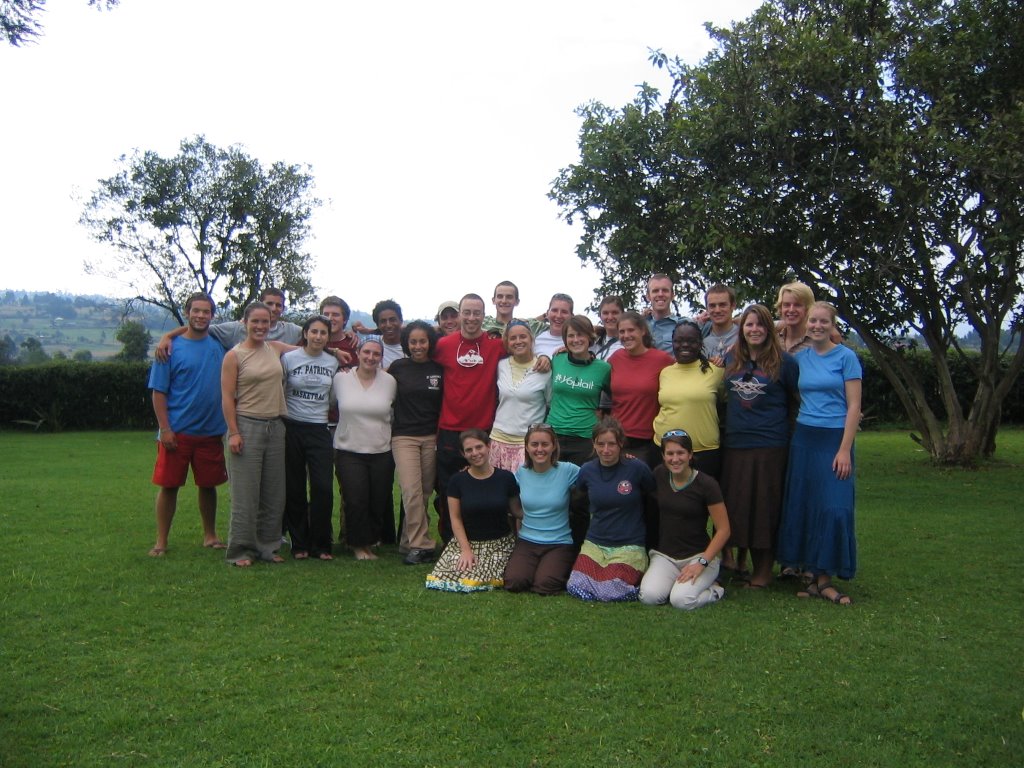
The entire group right before we got into the bus and drove to our homestays


Me and Dennis clearing a field with hoes


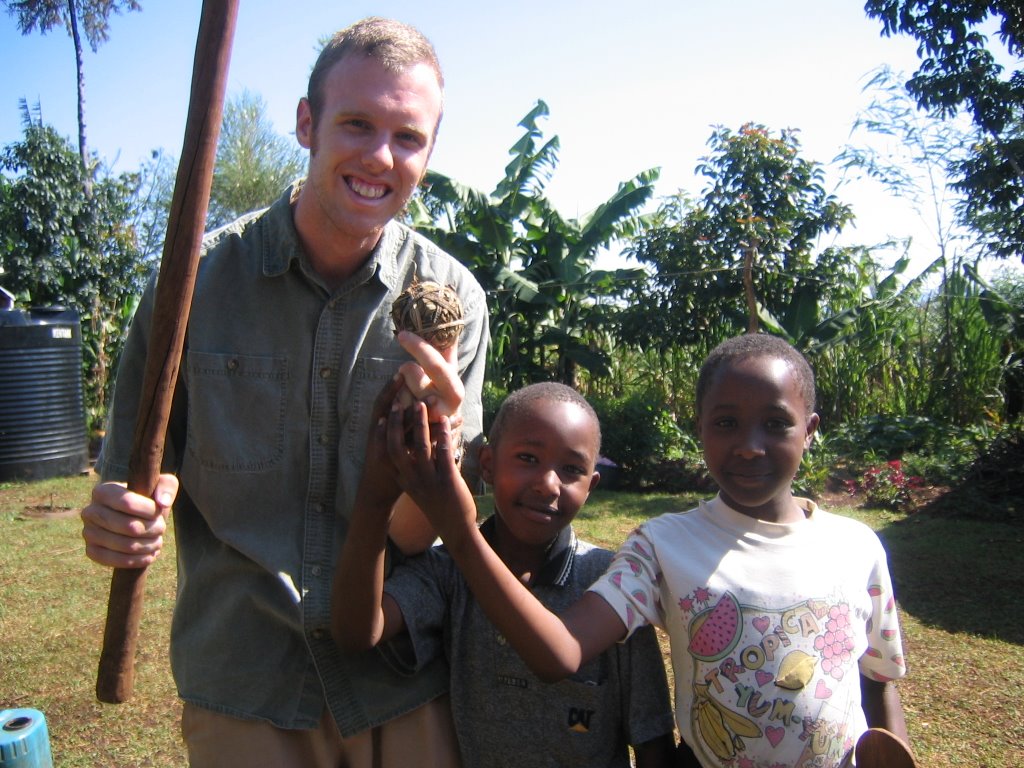
Me, Collins, and Halita holding the baseball we made out of banana fibers


Dennis, Collins, Tony, and Geoffrey with their Go Fish cards


Planting a tree I brought in the field next to where the calves graze

My Kenyan family

There's nothing like picking tea in the field and hearing Mama and my youngest sister quietly singing praise songs to themselves. There's nothing like playing baseball with a ball we made ourselves of banana fibers and a piece of firewood as a bat. There's nothing like holding my youngest brother's hand and herding the cattle home at the end of a long and satisfying day. There is absolutely nothing like an African smile. And there is nothing like being part of a family in rural Kenya.

I spent the past week living with a Kipsigis family in Chemosot, Kenya. My mother’s name was Betty, but I simply called her “Mama.” My brothers were Dennis, Tony, and Collins, and my youngest sister was Halita. I also had an eighteen-year-old sister I never met because she was completing her final year of secondary school and had a different holiday schedule from the rest of us. Baba (father) passed away three years ago and we had a family member named Geoffrey living with us who tended the cattle and helped with most of the male labor.

A typical day for me began at 7:00 after the sun was already well in the sky and the cattle had been taken to the pastures to graze. I would wash my hands and face with warm water before proceeding to eat breakfast: six sandwiches filled with butter or jam, at least two bananas, a boiled egg, pineapple, occasionally a cold sweet potato or two, and of course several steaming cups of hot milk with a little bit of tea, as I like to call it.

The morning was usually spent doing some sort of labor. The first day, we harvested maize by shucking each individual cob and throwing them in piles, then hauling them back to a grainery in several wheelbarrow loads. Another morning, we took hoes and cleared a field of weeds and grass to allow for planting. We also picked tea and brought it to a buying center for weighing before taking it to a factory to be processed and sold back to the people who grow it so they can drink it.

After a few hours of work we would gather in the yard for porridge. Porridge is a sort of millet slime that somehow captures the heat within itself so you feel the warmth go all the way down your throat and chest. It reminds me a bit of cream of wheat and I actually like it a lot in small doses. Unfortunately, absolutely no food item comes in small doses in this community. Accompanying the porridge was some sort of carbohydrate such as mandazi (a sort of fried dough), biscuit crackers, or boiled maize (corn on the cob) that did not taste or feel anything like American corn whatsoever. The kernels were bigger, harder, drier, and starchier.

Following this second breakfast of sorts, I would sit around with my brothers and we would talk or just stare into space for awhile. After a few days, I brought out a deck of cards and began teaching them card games. By the end of the visit, I had taught them Speed, Go Fish, War, Egyptian Rat Screw (which I renamed Royals), SlapJack, Hello Sir Hello Miss, Spades, Poker without gambling, and Spoons. They loved it and played every chance they could get.

At first, I felt weird introducing an activity into my experience which eventually took over most recreation time. I was worried about interfering with the community I was studying, but I ended up learning a great deal about sustainable development. In many ways, the cards represented a development program and I had to learn how to introduce them properly. At a certain point, I had to be disciplined enough to remove myself from the game and make sure they could continue playing once I left. There were also a few times where I became frustrated at the way they would change aspects of the rules, but I soon realized that I had to allow the games to adapt to their culture.

The best example of this happened when they were playing Speed. Speed is a two person game, but they involved every single person present. One person would hold the player’s cards for him and another would flip the next card over when a stack would run out. To me, it seemed chaotic but I realized that the communal nature of their lifestyle made this process allow the game to fit beautifully into their culture. To interfere in this process would be making the same mistake the World Bank and IMF made with Structural Adjustment Programs in the 1980s. Maybe if these organizations had tried introducing card games first, they wouldn’t have privatized land ownership and conflicts such as Darfur or wildlife degradation in Kenyan game parks would have never occurred. Maybe they would have realized that traditional agricultural practices actually make great use of the land and introducing a Western method might actually ruin the land and force people to relocate to an area that now “belonged” to another “tribe.”

Angry rant aside, the cards became a great learning experience for me and a fun activity for them.

I also introduced them to baseball, which was incredibly complicated to explain to people who had never even heard of it before. My acting training was essential as I tried to explain what a “force out” or “stealing a base” meant. In the end I’m still not sure they completely understood it, but we had a great time anyway.

My family lived a simple and humble life that deeply reminded me of my own upbringing. I shared a small room with my two brothers and Geoffrey who slept in a bunk bed...Dennis on top, Tony and Geoffrey on the bottom. We shared meals in a dimly lit room and sometimes said prayers together by the light of a lantern. While my family in the U.S. has always had electricity, I felt the same familiar closeness and reliance on one another that I have come to appreciate so much throughout the years.

The last night, Mama brought out a cake she had made that said “Logan, Kwaheri” in icing (kwaheri means “goodbye” in Swahili). After eating, she gave a type of speech thanking me for coming and delighting in the friendships we had formed. Then she had me say the prayer before we went off to bed. Somehow, I made it through without crying and realized in those moments what it means to be family in Christ. I will admit that I shed more than a few tears when I told them goodbye a few days ago.

There are many many other things to be said about my experience in Chemosot, but that is for a later time. If you are reading this, I hope you will ask me questions because I would absolutely love to answer them.

I am now back at the compound in Nairobi and ready to begin class tomorrow. In addition to Swahili and the core course on Culture, Environment, and Development, I am taking a Health and Medicine class and a Socio-Economic Development of Kenya class. After two weeks of study and staying at the compound, we head to Tanzania for a week, followed by three weeks in an urban homestay in Nairobi.

At the moment, I need a break from writing and will probably try to post some pictures before I eat dinner. Missing all of you,

Reynolds

Tuesday, August 22, 2006

Kiswahili and Kipsigis

The past two days we've been having Swahili class for four hours in the morning and I have over eight pages full of notes. We're learning so quickly that I can barely speak anything, even English, when we get out of class. I'm actually processing Swahili better than French, Arabic, and especially Latin. We're learning in groups of seven, which is nice and provides good individual attention. My teacher is engaging and challenging and has a great sense of humor. Hopefully when I get back I'll be able to communicate sufficiently at a basic level.

On Friday, I leave for a week to stay with a family in rural Kenya. The ethnic group is the Kipsigis and they are primarily tea farmers. My family is run by a single mother (the father is deceased) with five children who are all in school. We are encouraged to blend in with the family and operate as a guest only for the first night. After our first night we are expected to be treated and to act as another member of the family. I hope I can join them in the tea fields and learn how they operate in daily life. I will most likely be using a pit latrine (basically a hole in the ground) and bathing out of a bucket or bin. For me, this is the ideal way to really understand daily life in this area. I am incredibly excited, but trying not to go in with too many expectations. It's comforting to know that the program specifically requests that we not be treated differently. On my trip to Uganda three summers ago, many of the students were treated as royalty on their school visits and didn't get to experience life as the students who study there every day.

I'm also glad that we're not expected to bring our cell phones with us. I will be out of contact with anyone outside the community for the entire week, which will be relaxing and a much needed relief.

On another note, our time here in Karen and Nairobi has already been a lot of fun. Last night, we all went out to a bar in Karen and met some really friendly local people. I got destroyed in a game that somewhat resembled pool and had some great conversations with other students on the program. I also played four extremely intense games of ping pong on a table at the compound that is painted with the Kenya flag.

The compound itself where we're staying is EXTREMELY nice, even by American standards. It reminds me of Camp Greystone, a summer camp in North Carolina that costs $5,000 to attend for a few weeks. At first, I commented in my head "man, this just isn't Africa." But then I reminded myself that it's all Africa. This represents a part of society that is just as real as the huts, farming, goats, and traditional rain dances of other areas. In fact, it illuminates a fascinating contrast between rich and poor in Kenya that continues to be addressed in politics and daily street conversation. It's important not to impose one's own ideas of what Africa or any culture should look like. It's all real and it's all valuable to understanding the larger picture...the successes, the rich culture, the problems, and the solutions.

I may not write again for at least a week after we return from the homestays. I'm not sure. But until then, kwaherini.

Sunday, August 20, 2006

Into Africa

Wow, I don't even know where to start. My entrance into Africa has been so different from my past experiences. The last two times, I've eased into the culture by starting in a more upscale place and moving gradually into living with the local people in their homes and adopting their lifestyles. This time, I traveled alone to Nairobi, then got in a land rover with my uncle/second cousin and rode through the back country of Kenya and Uganda for a week. Now I'm in the nicest compound I've ever seen in Africa and I played volleyball on a freshly mowed lawn the first night I was here.

To bring everyone up to date, I flew into Nairobi on August 11th and met Joe Holt who is my mom's cousin. Joe is about 6'7" and absolutely huge. As soon as I met him, I felt I was in good hands. He's loud and friendly and fits perfectly in Africa.

We spent the first few days in Nairobi shopping for our trip and saying hello to about a hundred different people. Joe knows pretty much everyone. We also visited the old train yard and saw the largest functioning steam engine in the world which was used on the original Kenya/Uganda railway during colonialism. For those Africa nerds out there, this railway connected the Indian Ocean at Mombasa with Lake Victoria at Kisumu. The project took years, millions of British pounds, and numerous lost lives. For those movie buffs out there, the film Ghost in the Darkness about a lion that kills a bunch of people who are constructing a railway...that's the one. Anyway, I got a taste of history and got to see the bowels of a working steam engine for the first time.

On Sunday we climbed into the land rover with Joe's friend Dave and his son Tim from Canada, and headed to a game park called Masai Mara. This time of year is unique in this area because the animals of the Serengeti are migrating across the park and you are guaranteed to see hundreds and hundreds of zebras and wildabeests. We camped for two nights and saw tons of wildlife, including an elephant and a group of monkeys in our camp. The monkeys were climbing all over the tents and subtely moving closer and closer to our food. Luckily, the elephant wasn't as bold.

On the second day, Joe hired a Masai guide to sit in the passenger seat and help direct us to the animals. We saw dozens of animals including: lions, elephants, hippos, crocodiles, gazelles, zebras, wildabeests, giraffes, a leopard, a cheetah, warthogs, a hyena, and waterbuck. We had incredible luck the entire time. We saw a lion hunting a pack of zebras, crouching and crawling through high grass. We saw a cheetah eat a Thomson's gazelle, then proceed to sit in the shadow of our vehicle right outside my window. The thing was so close I could have reached out and poked it on the nose. Boop. We also saw a baby gazelle trying to drink milk under its mother. The mom wouldn't have it so the baby went over to another adult and nudged it, only to get head butted and shoved away. The baby was wobbly on its new legs and cute as a doorknob (I really couldn't think of a good simile there). We also visited a Masai village and saw them make fire with sticks. The Masai people are a pastoralist group in the Great Rift Valley of Kenya. They also performed a dance for us, which made me a little uncomfortable because I know the dance is specifically for tourists who have caused them to get kicked off their land. Overall, the experience was fascinating and I'm still trying to process everything.

After Masai Mara, we drove through the hills of Western Kenya up to Kisumu on Lake Victoria. My hotel room was on the fifth floor and had an incredible view of the lake and several islands. We basically just relaxed and enjoyed the area for a night before leaving the next day for Uganda.

We spent several hours trying to travel the several hundred feet between the Kenya and Uganda border. During that time, I talked with one of hundreds of begging children and showed him our guide book to Kenya. The thirst for knowledge and intense desire to learn here always blows me away. When we left, I gave him money to buy shoes and a picture of my family. That night, we arrived in Jinja at the source of the Nile.

The next day was completely absurd. I went whitewater rafting on some of the most powerful rapids in the world. We hit about eight level 5 rapids, which are the strongest that you can raft. Our boat flipped five times and I got sucked under more than once. I always resurfaced hundreds of feet downstream and never knew how close I would be to the boat. It was a blast. On most rapids you don't want the boat to flip because of the rocks, but the Nile is deep enough to be less of a hazard. We had lunch on the boat during a long flat stretch of river and I ate the best pineapple I've ever had.

From Jinja, we drove to Entebbe to spend the night and I caught a flight to Nairobi the next morning. Unfortunately, the engines on my plane were not functioning so I had to wait in the airport for four hours and miss the beginning of the study abroad program's orientation. It actually wasn't that big of a deal and I got a little extra time to unwind. And it didn't take me too long to get caught up and right in the swing of things once I got there.

The St. Lawrence University Kenya Semester Program (SLU-KSP) compound is in a wealthy suburb of Nairobi. It is the nicest place I've been in Africa. Maybe I'll post pictures at some point. My posts will be sporadic at this point because we are gone for weeks at a time without internet access. Anyway, the students on the program are wonderful and I'm already enjoying myself immensely. We went into Nairobi today and walked around in groups which was a nice orientation for me, even though I've been in the city twice before. There's something different about being on your own and knowing it will be your home for a few months.

I'm extremely tired right now, so I'm going to stop. I'm hoping to be able to go a little more in depth in future posts, but so much is happening so quickly right now that it's tough to keep up. Hope all is well back in the States!

Friday, August 11, 2006

Heathrow Terrorism

I'm sitting in Heathrow Airport in London waiting for my flight to Kenya. I find it absurd that I took the Eurostar yesterday and am flying on a plane out of Heathrow today, both of which were targets for the attempted terrorist attacks yesterday. You would not believe the security here. Anything you carry on has to be in a special plastic bag they provide. You can only bring your passport/essential documents and emergency supplies if you have a medical condition. They wouldn't even let me bring a packet of readings for the Kenya program with me. Luckily, I've only slept maybe 3 or 4 hours in the past 50 hours so I'll probably sleep most of the time anyway. There are also soldiers with machine guns, police with dogs, personnel with yellow vests, and many people with grumpy faces. I find it all kind of amusing, actually. I mean, we're all so equally helpless under the system. If they want to x-ray my entire body in lieu of normal security procedures (which they did) I just nod and take off my shoes and belt. Several times in the last few days, especially in the middle of the night, I've just started laughing at it all. Which made me laugh more last night because I was just standing by myself in my underwear in a random London airport hotel...laughing. I guess I'm not that terrorized. Sorry, Al-Qaeda. Well, I'm going to go find my gate now and see what other adventures are in store. Hopefully, the next post will be from Kenya. Peace.